Using AI to Boost Recycling at the World’s Busiest Airport
Editor’s note: This article was first published in Global Atlanta, an online news publication devoted to revealing the city’s ties with the world and helping local companies navigate the global economy. It was written by Managing Editor Trevor Williams and is published here as part of a content partnership with Hype. Subscribe to Global Atlanta’s newsletters here and keep up with the latest here.
It happens to the best of potential recyclers, that paralysis at the point of disposal.
“We’ve all been in that situation where you stand above the trash can, and you have no idea if this is regular trash, recycling, composting,” says Malaz Alhirsh, sustainability analyst at the world’s busiest airport in Atlanta. “That happened to me yesterday at a conference. I was like, ‘What do I do?’ We play that guessing game.”
For Hartsfield-Jackson Atlanta International Airport, which sees more than 100 million passengers each year, most of them doing a bit of dining, drinking or shopping, the stakes are high for the environment — and for the airport’s own sustainability goals.
ATL has already replaced its toilets with water efficient versions, added 100 charging stations at the new red parking deck, experimented with compostable service ware and added water refill stations to reduce the use of plastic bottles, among many other low-hanging efforts to address the environmental byproducts of what is already seen as a polluting activity: air travel.
But waste diversion had remained a stubborn problem as the City of Atlanta, which has authority over the airport, remains far short of its goal of keeping 90 percent of trash collected out of landfills.
How to sort different streams, and at which point to do so in the collection process, has long been on the minds of airport officials. In 2009, it introduced GreenSort ATL, an experiment to fix the problem on the back end through single-stream disposal, but the recyclables proved too contaminated to recover. The airport later unsuccessfully tried, over multiple years and requests for proposals, to find a contractor to build a waste-sorting facility code-named “Green Acres” on airport grounds. The project never materialized.
But now a solution emerged that could tackle the problem at the source through education, technology and a little bit of gamification, all powered by artificial intelligence.
Vancouver, Canada-based Intuitive AI’s founders grew up in India and Pakistan, places where they could see the results of waste uncontained, and how the West’s waste problem eventually flowed down to the developing world. About a decade ago, they began looking at robotics and AI as a solution.
At the start, they built an enclosed box that would take a human out of the loop. But that wouldn’t address the behavioral problem, that three-second decision that humans get wrong 70 percent of the time, co-founder Hassan Murad said in a Tedx talk. And who came blame us, with at least 9,000 different local recycling regulations counted across the United States?
“So rather than handing somebody the fish, we really knew that we had to teach people how to fish,” Mr. Murad said.
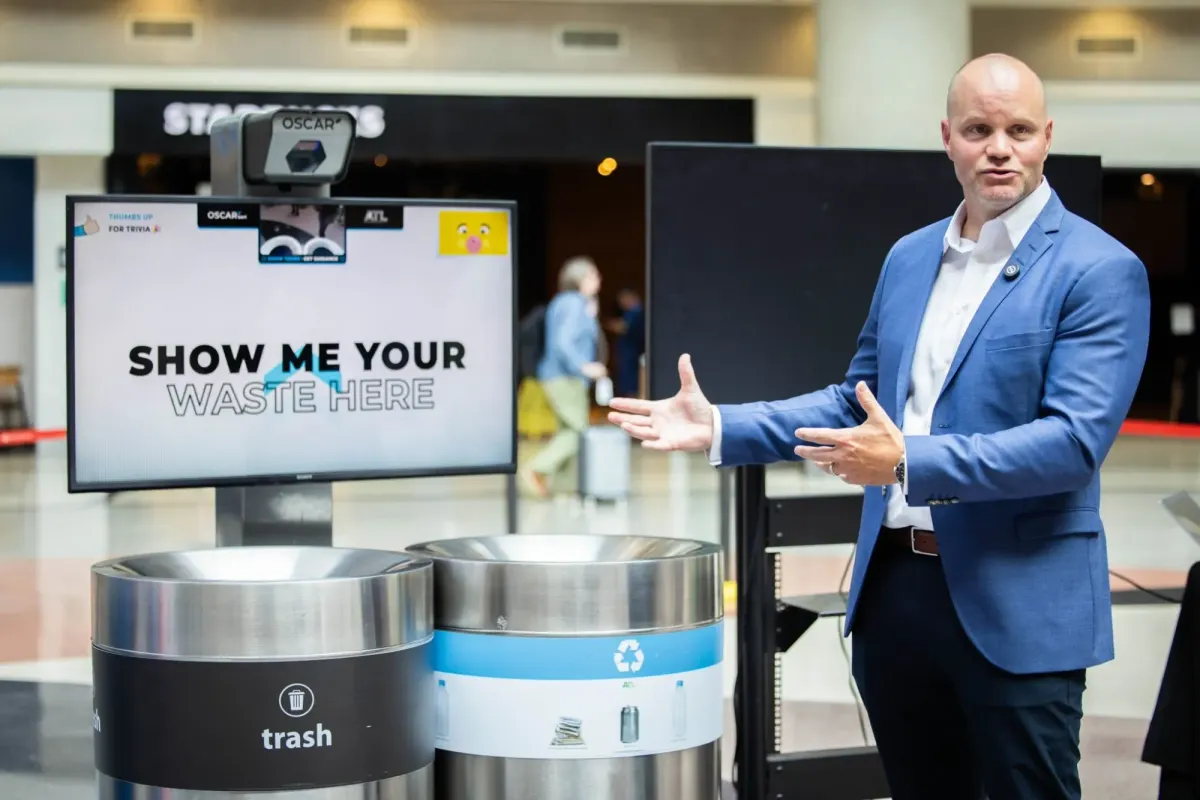
They created Oscar, an AI that sits on top of waste bins, equipped with a screen and a camera that recognizes each waste item, then helps the user dispose of their trash. Right decisions are rewarded, while the Oscar, like its namesake character in Sesame Street, can get grouchy if, for instance, the various parts of a coffee cup — cup, lid, sleeve — are not separated correctly. Or if a banana is put in the recycling bin.
As the system made its way through university campuses, sports venues, corporate offices and airports, the system started to live up to the company’s name. What was once a source angst has become something close to fun, to the point where kids have been seen picking up trash in terminals to come and engage with the Oscar. Airports particularly caught on, and deployments in Boston, Winnipeg, JFK, LaGuardia, Phoenix and others seeing the system’s data capabilities and adaptability as strengths.
“There’s a saying in aviation —‘Once you’ve seen one airport, you’ve seen one airport,’” says Corey Morrow, enterprise sales lead at Intiutive. “Each airport completely differs in the way they do everything.”
But that doesn’t keep them from sharing ideas. It was at an aviation conference that Dr. Quinta Nwanosike Warren, the Atlanta airport’s sustainability director, learned from Seattle-Tacoma International Airport about the Oscar’s charms.
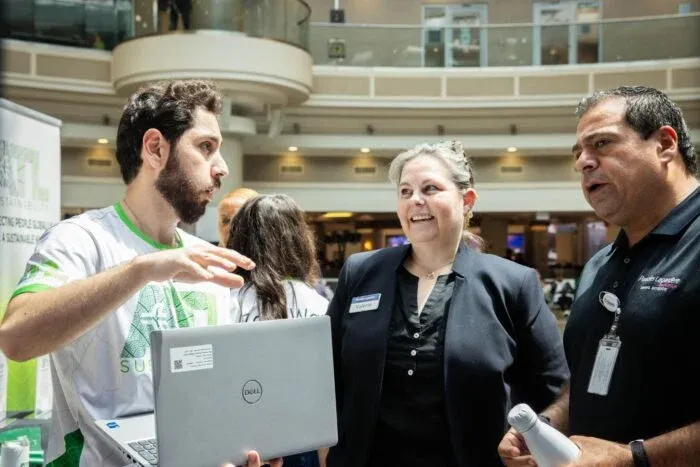
In July, ATL unveiled its first 10 Oscars, placing them strategically throughout some of the airport’s nine concourses in high-traffic food-court areas, said Mr. Alhirsh.
Already, 2.5 million people have utilized the bins, with about 250,000 interacting with the Oscars, and the data rolling in has started to impact policy decisions made by airport leaders, who have to balance stakeholders as diverse as the Federal Aviation Administration and the city council, he said.
That’s part of the Oscar promise, said Mr. Morrow. More locations make the “three brains” of the system even smarter as more decisioning data is collected.
Each Oscar — whose AI doesn’t capture images of faces and operates on edge so it’s not constantly querying the cloud, the company said — learns on its own, then feeds its data back up to the cumulative layer, say the airport data dashboard, which also learns. At the global level, Oscar’s systems can take lessons from a new waste item in a place like Australia and apply them to the “decision trees” localized to a place like Atlanta. Regulation changes can also be accounted for with a remote software update.
On average, the company says, recycling improves by about 61 percent after a deployment, and in certain environments like the World Cup stadiums where Oscars gained significant visibility this summer across the U.S. and Canada, the screens can be tapped for advertising and fan engagement, raising revenue that can be used to offset their costs. (That function is appealing to the likes of beverage giants Coca-Cola and Pepsi, which are supplying some units to venues where they have pouring rights.)
The data collected has been invaluable for ATL, Mr. Alhirsh said, because it gives real-time visibility into the waste stream, enables testing of messaging and helps with passenger engagement and satisfaction through trivia, gamification and rewards.
“Our conversation is around what kind of signage we need to use to make sure the passenger understands what they have from a waste stream perspective and where they can throw that out, because that’s certainly where the hurdle is,” Mr. Alhirsh said.
And even when an Oscar is not present, the hope is that the interactions with it will change consumers’ habits, which is where an even greater environmental impact lies, Mr. Morrow told Global Atlanta.
“If we’re able to improve recycling by about 10 percent, that is the equivalent of removing about 2 billion cars off the road.”