
Could Algae be the Solution for Outdated HVAC Systems?
Editor's Note: This article was originally published by Hypepotamus' content partner Tech Square ATL.
The machine that heats and cools nearly every commercial building in America has barely changed in decades. It still works the same basic way it always has, drawing air in and pushing it back out, burning energy the whole time. Mark Snyder looked at that loop and saw a problem worth solving. His Atlanta startup, VerdeTerra, wants to change what happens to the air once it is inside, and it is reaching for one of nature’s oldest tools to do it: algae.
From Honda to sustainability
Snyder is a mechanical engineer by training whose career took him through Honda R&D, defense and aerospace contracts with the likes of NASA and DARPA, then on to Porsche Consulting, where he helped companies turn new technologies into practical business strategies. An MBA in Italy and an exchange program in Shanghai broadened his perspective and highlighted the need for more sustainability. “I see the data, I want to help,” he said.
Management consulting taught him something that still shapes the company. “Good intentions do not keep a project alive,” he said. “Sustainability initiatives, if they don’t make money, they will be cut. If the CFO isn’t interested, it’s not happening.” He went looking for a target where saving carbon and saving money pointed in the same direction, and heating and cooling kept coming up.
A system stuck in place
Heating and cooling systems must move air, and moving air takes power. By Snyder’s math, roughly 20% of the energy an HVAC system burns goes to bringing in and conditioning outdoor air. Across U.S. commercial buildings, he estimates that share adds up to about 85 billion kilowatt-hours a year, a figure he calculated from the Energy Information Administration’s most recent Commercial Buildings Energy Consumption Survey. The industry has spent decades improving efficiency but has left room to rethink how the system fundamentally works.
The air-quality side has its own blind spot. Most purifiers on the market capture dust and particles but do nothing about carbon dioxide (CO₂) and volatile organic compounds (VOCs), gases that are built up in closed, occupied rooms. Newer construction makes the problem worse. Tightly sealed buildings trap indoor pollutants in ways older, leakier homes never did, and researchers increasingly tie poor indoor air quality and inadequate ventilation to respiratory problems in children. The Royal College of Paediatrics and Child Health has pointed to growing evidence linking indoor air pollution to those problems, and a 2024 expert consensus in the Italian Journal of Pediatrics named poor ventilation among the main risk factors for unhealthy indoor air.
Nature’s own filter
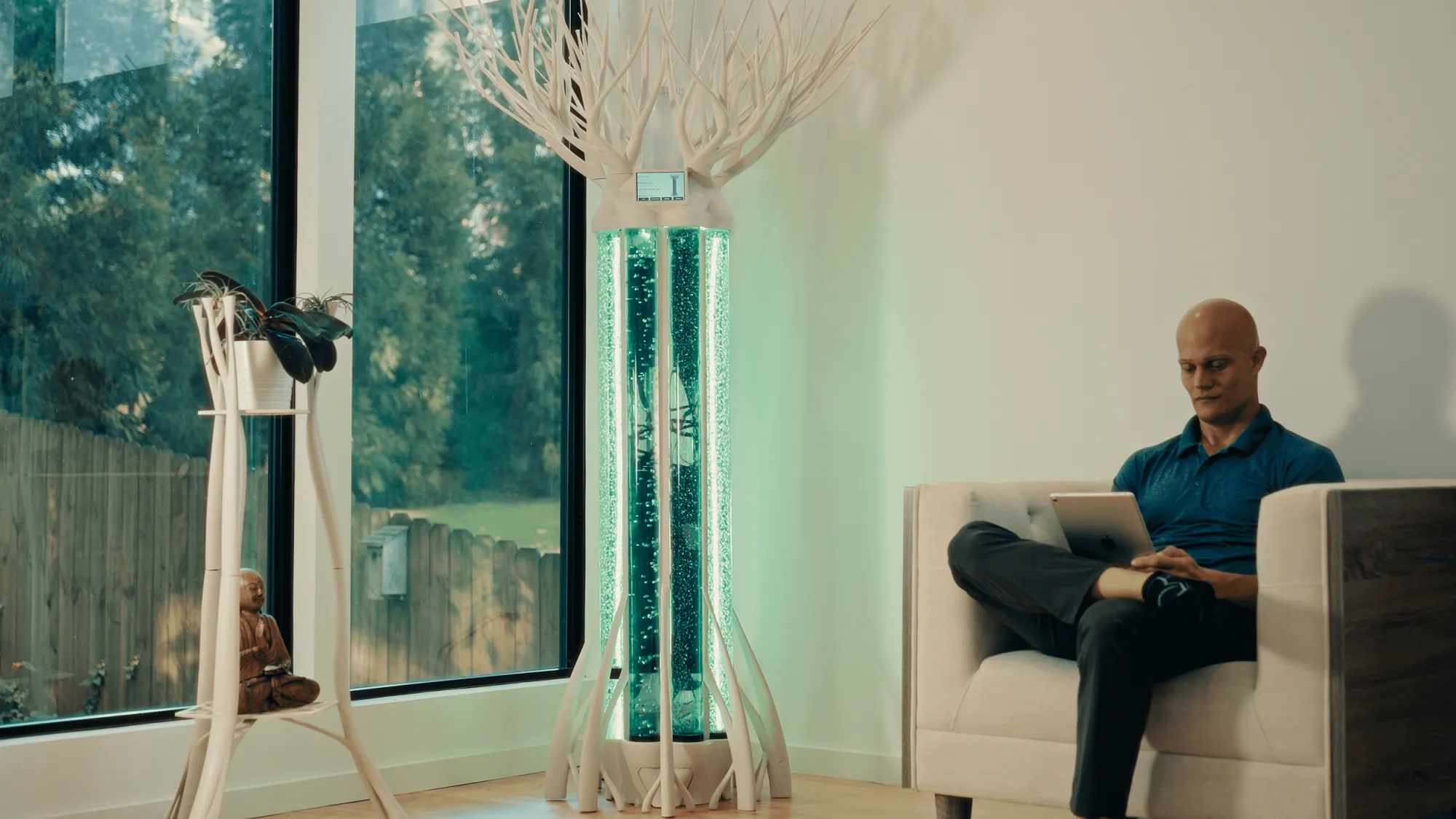
VerdeTerra’s answer is algae. The organisms consume carbon dioxide and VOCs as they grow, and Snyder’s team has built a system that puts them to work indoors. In testing with a Georgia Tech civil and environmental engineering lab, researchers looked at how well the company’s Albero unit cleared different VOCs from the air. Separate closed-system testing, which VerdeTerra published in a white paper, found the approach to pulling CO₂ from the air far more efficiently than activated charcoal, a material commonly used in air-purifier filters. The company is part of the Advanced Technology Development Center (ATDC), Georgia Tech’s startup incubator right here in Tech Square, and its research earned a grant from the Environmental Protection Agency.

“Algae, is quite simple,” Snyder said. “They use carbon to grow, absorbing CO₂ and releasing oxygen through photosynthesis. Certain algae also use enzymes to break down some VOCs, potentially using their carbon to support growth. VerdeTerra brings that biology indoors by providing the systems and conditions the algae need to stay productive.” The company has posted its research on its website.
Two products, one goal
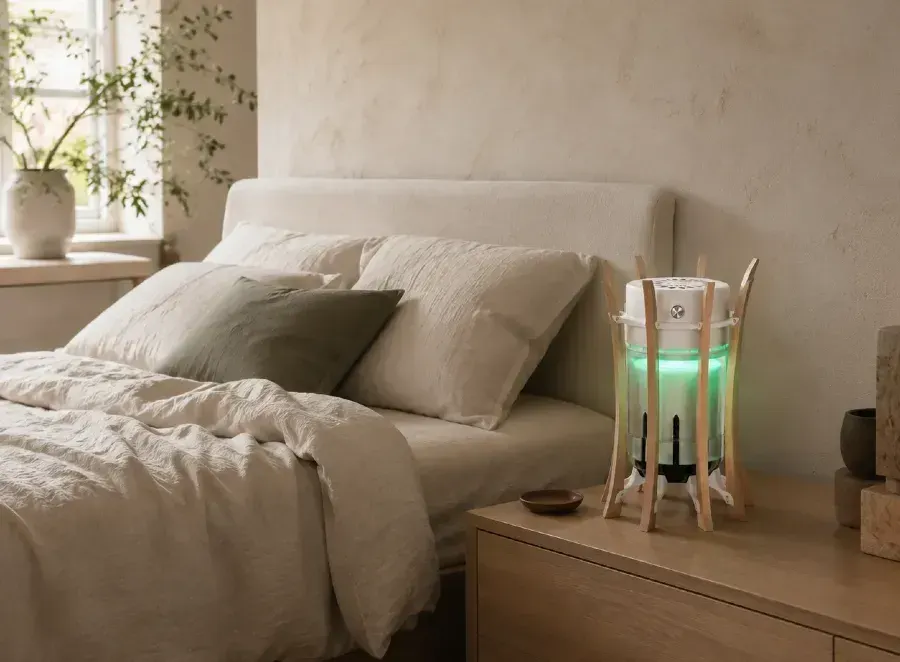
VerdeTerra is pursuing two markets, starting with the home. Its compact air purifier, Alberello, is available for early reservations at $700, with a care plan to refresh the filter, nutrients, and algae every six months. It offers the clearest path to a broad market and a way to support the company’s next stage.
The longer-term goal is to integrate the technology into the HVAC equipment buildings already use. That requires further engineering and field testing to understand how the system performs as occupancy and air quality change throughout the day. VerdeTerra plans for Alberello sales to help fund that development, moving the company toward larger installations with the potential to reduce both indoor pollutants and HVAC energy use.
“Alberello lets us bring the technology into people’s homes to help now, learn from everyday use, and build toward larger commercial systems tomorrow,” Snyder said.