
Booming Business: Atlanta Firm Creates Cleaner Way to Sop Up Oil Spills

Editor’s note: This article was first published in Global Atlanta, an online news publication devoted to revealing the city’s ties with the world and helping local companies navigate the global economy. It was written by Managing Editor Trevor Williams and is published here as part of a content partnership with Hype. Subscribe to Global Atlanta’s newsletters here and keep up with the latest here.
When Atlanta-based Green Boom started to take its sustainable oil spill cleanup solution on the road, salespeople carried around tiny absorbent socks inside a lidded plastic Tupperware bowl.
The idea: Fill the container with water, add some olive oil, then show how a cotton tube filled with biomass sorbent would soak up just the oil without taking on moisture. A tidy demonstration how to fix a catastrophically dirty problem.
But one prospect wasn’t having it.
“The guy said, ‘Uh-uh.’ He picked up a gallon jug of oil and he threw it down on the ground, and he said, ‘I want to see it on my floor against what I’m using right now,’” said Parker Pruett, the Norcoss company’s vice president of operations.
Mr. Pruett admits he wasn’t sure what would happen, but Green Boom’s solution outperformed the traditional “kitty litter” sorbents made from clay, and from that moment, its pitch took on a new urgency.
“That was the point at which we knew that we had a product where we could say the performance is that much better than all the other stuff,” Mr. Pruett says. “We’ve not seen anybody not impressed with the product.”
Not that the sustainability play wasn’t part of the company’s founding ethos. Green Boom was born in the aftermath of the unprecedented 2010 Deepwater Horizon oil spill in the Gulf of Mexico. Co-founder and CEO Sudhir Sharma, a Georgia Tech Ph.D. and chemical engineer, started wrestling with how to actually clean up spilled oil instead of just moving the problem from the ocean to the landfill.
In disasters, remediation agencies surround spills with floating, sausage-shaped booms filled with polypropylene — itself a plastic. Once the oil is soaked up, these are thrown into the landfill, never to decompose.
Dr. Sharma and Georgia Tech emeritus professor Yulin Deng, the other co-founder, set out to create a bio-based, circular solution that would not only eliminate this waste, but also deal with the problem of the residual oil trapped within those booms.
Their solution? A sorbent made from treated renewable fibers, stuffed inside a “hydrophobic” sheath made of cotton, also coated to stay dry even while letting the oil in.
These natural materials, which contain interior veins or channels where water once ran, give Green Boom’s products a higher rate of absorbency, Mr. Pruett said as he gave Global Atlanta a demonstration at the warehouse.
Then comes the piece de resistance: Once the oil is collected by Green Boom’s pillows, booms, socks or pads, it can be placed in a bucket with another add-on: Oily, a microbe that consumes oil, leaving behind a compostable material.
“Instead of the oil being constantly trapped inside the plastic, the oil decomposes over time, and when the products are disposed of, they biodegrade over time, leaving no trace in the end,” Dr. Sharma said during a presentation to a German state in Atlanta in 2022.
It’s the first “oil to soil” product in the industry, the company says.
Pursuing New Verticals
As huge as the opportunity is in oil spills, especially with the growth of environmental consciousness, it can be an unpredictable sales cycle, Mr. Pruett said.
“It’s big, but it’s feast or famine. It’s BP, and then it’s nothing for 10 years,” he said.
Green Boom’s spill kits, which help disaster agencies respond quickly and decisively in the event of a spill, may not need to be replaced for years.
The company has built out a robust e-commerce business, building a presence on most major online retailers, from industrial supply site Grainger to Amazon and Walmart.
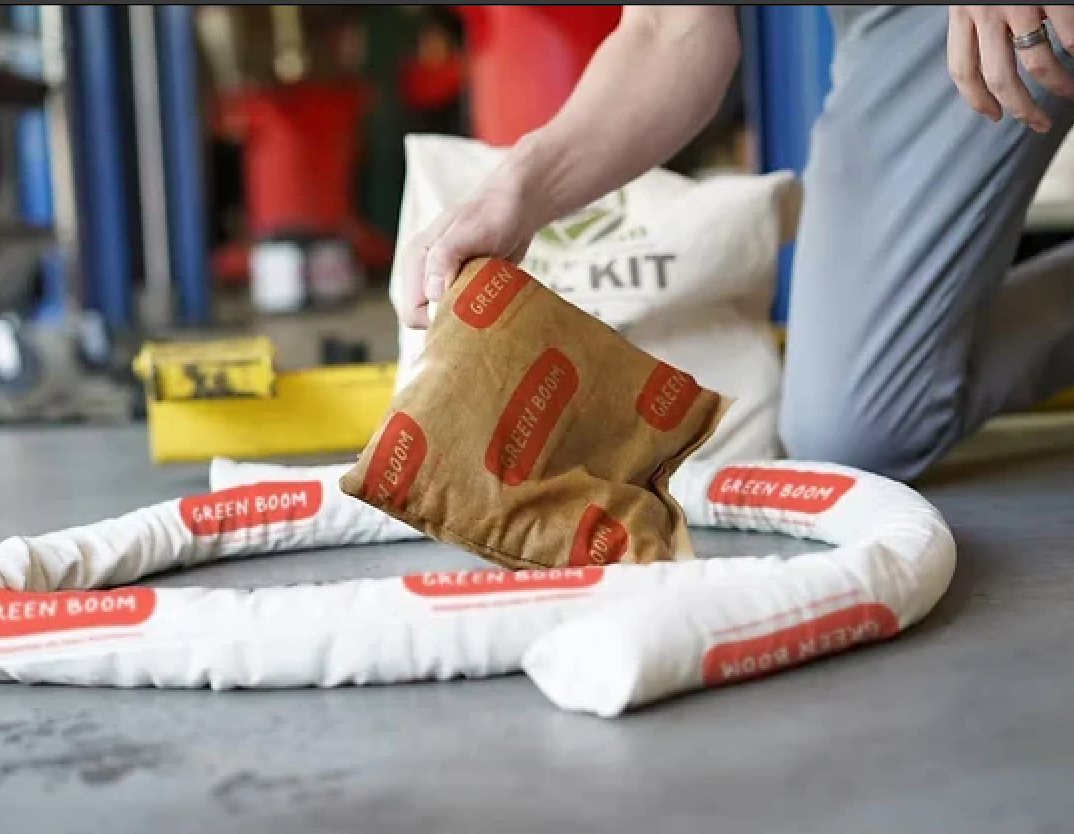
But its biggest hit may have come by chance when the company was approached by NAPA, the auto parts retailer owned by Atlanta’s Genuine Parts Co., to sell loose sorbents — the fiber without the cotton sock — to auto shops and garage hobbyists.
“NAPA was like, ‘Yeah, we just don’t sell much sorbents,’ and then they started thinking, ‘Wait a minute, why don’t we sell much sorbents?” Mr. Pruett said.
A pilot program in Atlanta turned to all 25 in Georgia, and now, Green Boom is packing blue NAPA buckets emblazoned with its brand to send out to retail outlets across half of the United States, with two full-time salespeople hitting the road daily.
Recalibrating Global Expansion
Green Boom started out with global ambitions, piling up certifications needed to sell in markets beyond the U.S., from the DIN CERTCO mark of biodegradability in Europe to a Nigerian Ministry of Petroleum seal of approval. These go on top of U.S. approvals like a “non-objection letter” for the EPA, a similar clearance in California and the USDA’s Bio-Preferred mark.
Early on, Green Boom joined the Swedish-American Chamber of Commerce, courted North Rhine-Westphalia in Germany and even announced a deal with Qatar for manufacturing and distribution in the oil-rich Persian Gulf nation.
In a move that looks prescient now, Green Boom has backed out of that region, while it has remained present in Europe, serving the market through a distributor based in the United Kingdom. Canada has also proven a promising market due to recent legislation.
Overall, however, the company is taking a more methodical than scattershot approach, understanding that the quantity of oil oil a region is less important than the desire and need — based on habit or regulation— to clean it up.
Being bigger in the U.S. also comes with some built-in advantages.
“What we’ve learned is that what’s most important for international business is to be an established quantity in the United States,” Mr. Pruett said. “Because if you can sell in the United States, you’re Coca-Cola, you’re Levi’s jeans. You’re Microsoft. I mean, you’re a real name.”
A differentiator is vital, no matter how pure the product ma be environmentally, as the green story alone is not always enough to command a premium.
“You’ve got to find that, because we’re still probably about 10 to 20 percent more expensive than the competitor, but we’ve got performance benefits that the other people don’t.”
Even the green benefits have gradations, a not all customers push the product to its circular conclusions.
“In a perfect world, customers buy our products and have zero waste on their spills. In reality, customers buy our products because it reduces their carbon footprint and avoids single-use plastics.”