Homegrown Is Building The Online Farmers Market Shopify Never Built
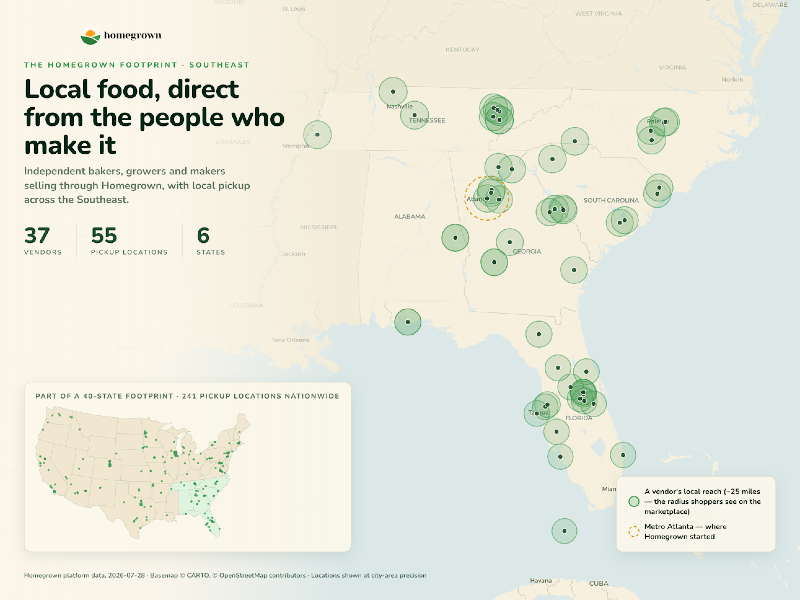
ATLANTA, July 29 (Hypepotamus) - Local bakers, ranchers, and cottage food makers have long relied on Instagram DMs and Venmo to run their businesses. Homegrown wants to replace that patchwork with an online storefront…and one that actually helps people shop more locally.
Building A Storefront & A Marketplace
On the backend, Homegrown provides food vendors with the online ordering, payments, and delivery logistical solutions they need to sell to local customers.
It is filling a food gap that ecommerce giants like Shopify don’t fill, since the platform is built specifically for the needs of smaller vendors with a hyperlocal audience.
Live Oak Bank's (NYSE: LOB) Venture Banking team provides non-dilutive growth financing that complements equity, along with tailored banking solutions, for venture-backed B2B software and healthcare companies at every stage of their financing journey. We understand entrepreneurs because we are entrepreneurs. Member FDIC
As co-founder Evan Knox told Hypepotamus, vendors come to Homegrown for the tools, but stay for the network.
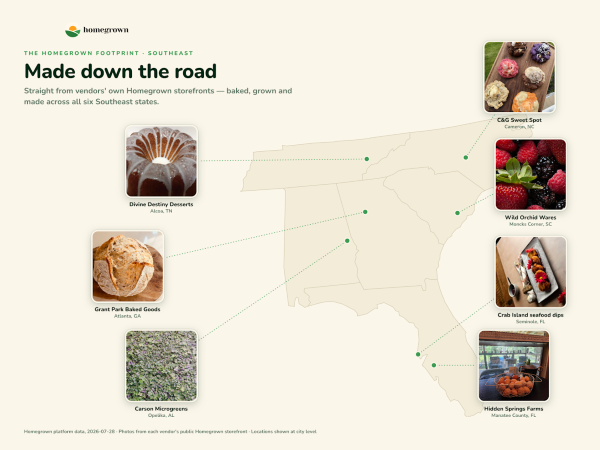
Homegrown works ultimately works as an “online farmers market,” connecting vendors with the customers ready to buy from them online. Vendors can sell their products and have it picked up or delivered. For Knox, this opens up more sales opportunities to vendors who sell out of their home and don’t have a brick and mortar location.
Now, building a marketplace startup business is notoriously difficult. For Knox, Homegrown’s value is in its simplicity.

“Marketplaces are hard because you need both sides at once. Vendors won't come without shoppers, and shoppers won't come without vendors. So we don't sell vendors on the marketplace. We sell them on the easiest way to sell their products locally, which is just a tool, and it works on day one whether or not anyone else has joined. Then once they're up and running, we're betting that as the network grows some of them start getting orders from people who never would have found them otherwise,” Knox added.
Vendors pay a flat subscription of $12.50 a month (with annual subscription options available) and the platform does not take any sort of commission.
A Bootstrapped Bet
Knox is building Homegrown (legally named Innovation Harvesters Inc.) alongside co-founder David Hollins. Knox, who is based out of Atlanta, has scaled five previous companies to an exit. Homegrown is bootstrapped and just reached breakeven at the two-year mark.
Knox told Hypepotamus that his previous experience building companies impacted how he is thinking about building Homegrown. His advice?
“Do the work nobody else is willing to do. It's unglamorous and it doesn't scale, and that's exactly why there's an advantage in it,” he said. For Knox, that looks like personally emailing every sign up and every vendor who cancels.
“What I learned the hard way is that the minute you stop talking to customers directly, you start building off your own theories instead of what people actually need. So I stay in the inbox way longer than most founders probably would. Right now that looks like fighting hard to keep every early customer while the product gets more mature,” Knox said. His other piece of advice: Build demand generation at the same time as the product.
 Maija Ehlinger
“The ads, the cold email, the blog, the outreach, all of it has been running while the product is still in its early stages. Most people wait until they have something polished to sell. Doing it early got us real product market fit signals a lot sooner, and reading which messaging and offers actually worked in advertising told us what direction to take the product.”
Keeping Money — And Vendors — Local
Helping people shop locally keeps more money in the local economy. But for Knox, it's also about backing the next generation of small vendors. As he sees it, the AI wave will push more people toward side hustles and physical products — and Homegrown is a way to give those vendors real infrastructure to sell on, instead of just a Venmo link and an Instagram following.
See more Hypepotamus stories in your search results
Photos provided by Homegrown